


Japan Travel 2026: Tax-Free Shopping, Costs & a First-Trip Route
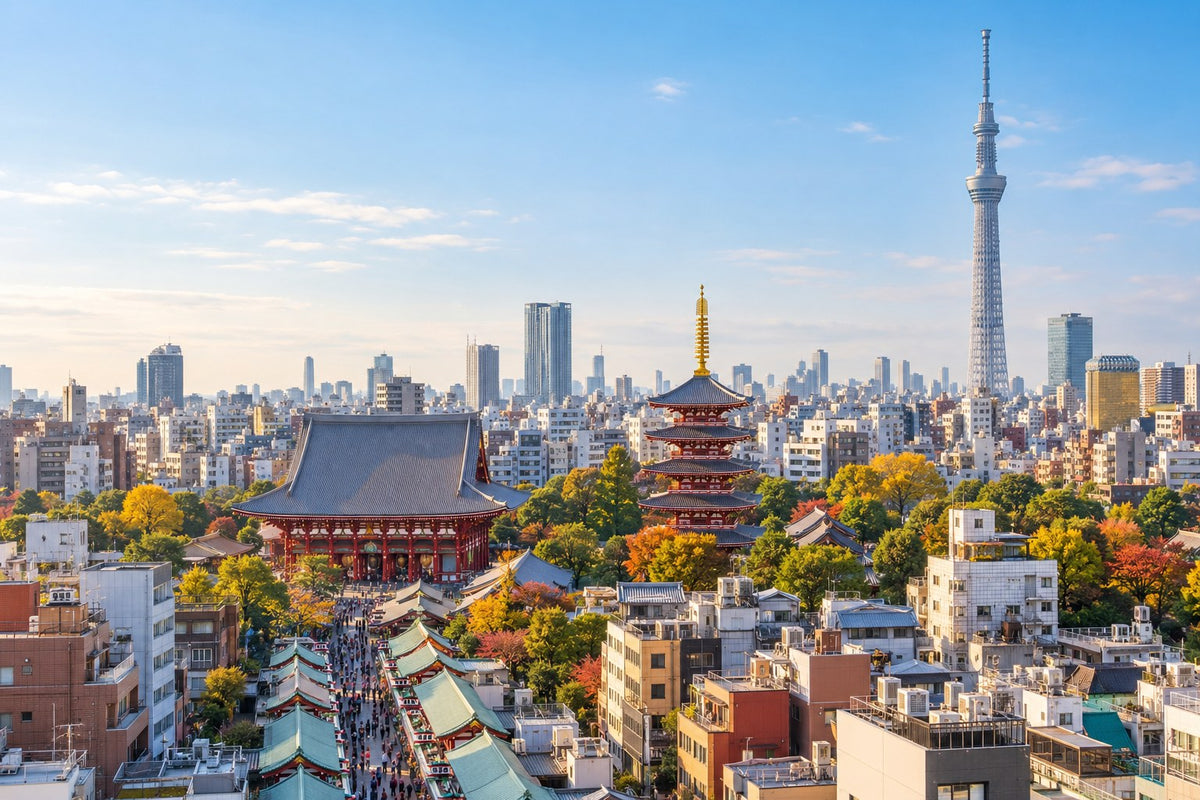
Japan’s tax-free shopping rules change on 1 November 2026. For eligible purchases made from that date, you will pay the tax-inclusive price first and receive a refund after the export procedure. The purchase date matters: arriving in October does not keep your November shopping under the earlier system. Japan Tourism Agency: the new refund method.
That is the headline, but it is only one part of planning a good Japan trip. Your hotel location, intercity trains and number of hotel changes can matter more to the overall budget than a shopping refund. This guide connects the new rules with the practical decisions behind a first Tokyo–Kyoto–Osaka journey.
Checked on 20 October 2026. Official rules and published prices are linked beside the relevant facts. Route suggestions and the sample budget are Leeylo’s planning examples, not live booking quotes.
What changes for tax-free shopping in Japan in November 2026?
Tax-free shopping is continuing; the way eligible visitors receive the benefit is changing. Think of the new arrangement as pay first, complete the export check, then receive the refund. Do not build your spending limit around paying a reduced amount at the shop.
- Purchases through 31 October 2026: the existing exemption-at-purchase system applies to eligible transactions at participating tax-free shops.
- Purchases from 1 November 2026: pay the tax-inclusive price at a participating shop. The refund follows confirmation that the goods are leaving Japan.
- The shopping threshold: eligible purchases must total at least ¥5,000 before tax at the same shop on the same day.
Read the official English explanation and eligibility documents. Check that your visitor status qualifies; a foreign passport alone is not a universal guarantee of eligibility.

How the new Japan tax-free refund process works
- Check at the shop. Confirm eligibility, the transaction procedure and the refund provider. Ask how to register your refund details and whether any service fee applies.
- Keep the purchase together. Retain the goods and the transaction information so that you can match what you bought to what you are taking home.
- Complete the departure procedure. Present your passport at the tax-free terminal within 90 days of purchase. A green result completes the check; a red result sends you to an inspection area with your goods.
- Follow the refund instructions. Customs confirmation is part of the process. The shop or its refund provider handles payment; follow that provider’s method and timing.
JNTO’s explanation for travellers and the Japan Tourism Agency’s traveller FAQ cover the procedure and refund arrangements.
The airport step goes before bag drop
The tax-free terminals and inspection areas are in the international departure lobby before baggage check-in. Have all relevant goods available before handing luggage to the airline. For a domestic connection followed by an international flight, the procedure takes place at your final departure airport in Japan. Official English traveller leaflet.
Put this sequence in your departure-day notes: tax-free procedure, then bag drop, then the remaining airport formalities. Allow additional time beyond your normal airport plan; an inspection or queue has no guaranteed duration. Airline baggage and liquid restrictions still need to be followed.
Three tax-free shopping mistakes worth avoiding
1. Mixing export purchases with things you will use up in Japan
Food, drinks and cosmetics consumed in Japan do not qualify for the export refund. More importantly, the official guidance treats an individual purchase transaction as a unit: if even one item on that receipt cannot be presented, the other goods on that receipt are not eligible for the refund either. Official FAQ on goods and receipts.
Our practical approach: tell the shop which items you intend to take home and ask to keep everyday consumables separate. A snack for tonight and an unopened gift for home have different roles. Keep a simple phone note listing export purchases rather than reconstructing everything on departure morning.
2. Assuming every refund is immediate or paid in cash
Ask the shop how its provider pays and how you can follow up. Keep those instructions until the transaction is finished. If your plan depends on using a refund for the next hotel payment, change that plan.
3. Calculating a percentage of the wrong amount
Here is an arithmetic example, not a promise of the amount you will receive: if an item costs ¥11,000 including tax at an assumed 10% rate, its pre-tax price is ¥10,000 and the included tax is ¥1,000. It is not ¥1,100. Your actual refund depends on the applicable tax treatment, eligibility and the provider’s terms or fees.
For planning, record three separate numbers: the amount you pay today, the amount potentially refundable and the amount finally received. That keeps a shopping budget honest.
Japan travel taxes in 2026: Kyoto hotels and the departure tax
A tax-free shopping refund, a local accommodation tax and the international tourist tax are different charges. One does not cancel another. Put each in the right part of the budget instead of adding a vague “Japan tourist fee” to every booking.
Kyoto accommodation tax from 1 March 2026
Kyoto City’s accommodation tax is charged per person, per night, according to the accommodation charge excluding meals and consumption tax. The revised bands are:
| Accommodation charge per person / night | Tax |
|---|---|
| Under ¥6,000 | ¥200 |
| ¥6,000 to under ¥20,000 | ¥400 |
| ¥20,000 to under ¥50,000 | ¥1,000 |
| ¥50,000 to under ¥100,000 | ¥4,000 |
| ¥100,000 or more | ¥10,000 |
Check whether your booking already collects this tax or whether it is payable at the property. A room price for two people is not automatically the per-person amount used to choose the band. Kyoto City’s official multilingual tax guide.
Japan’s international tourist departure tax
The general departure tax increased to ¥3,000 from 1 July 2026. Transitional treatment can leave qualifying transport contracts made before that date at ¥1,000. It is normally collected through the airline or shipping company, so check your ticket’s charges before adding it again to a trip total. Exemptions also apply in defined cases. National Tax Agency: current international tourist tax information.

How much should you budget for a 10-day Japan trip?
Start with a worksheet rather than a universal daily price. A solo traveller in a private room, two people sharing a room and a hostel traveller are buying different trips. Season, neighbourhood, cancellation terms and the number of long-distance moves all change the result.
The example below is a Leeylo planning scenario for one person sharing a room with one other adult, over 10 days and nine paid nights. These are deliberately editable allowances, not researched market averages, current hotel quotes or a recommended minimum.
| Assumption | Allowance |
|---|---|
| Accommodation: ¥8,000 × 9 nights | ¥72,000 |
| Food and drinks: ¥4,000 × 10 days | ¥40,000 |
| Local transport: ¥1,000 × 10 days | ¥10,000 |
| Intercity travel: replace with your actual route | ¥30,000 |
| Paid visits and experiences | ¥10,000 |
| Subtotal | ¥162,000 |
| 10% planning reserve | ¥16,200 |
| Illustrative total | ¥178,200 |
Add separately: international flights, insurance, connectivity, shopping and any accommodation tax not already in your room quote. Replace the intercity allowance with actual tickets or a suitable pass, including relevant airport transfers. Do not use this figure as a door-to-door trip price.
To reduce the total, first test fewer overnight bases and fewer long-distance journeys. Then compare room types and locations. A cheaper bed can be poor value if it adds an awkward transfer to every morning and evening; an expensive central room is not automatically worth it either.
Is the Japan Rail Pass worth it in 2026?
It depends on the journeys you will actually take. On 20 October 2026, the official online price for an adult seven-day Ordinary Japan Rail Pass is ¥50,000; the same site lists different prices for overseas agency purchases. NOZOMI and MIZUHO services require a separate additional ticket for pass holders. Check the official price and purchase conditions.
A 10-day holiday does not automatically require a 14-day pass. You might spend several days in Tokyo before beginning the intercity portion. Equally, a pass that looks convenient can be poor value if your plan only contains a small number of eligible long-distance rides.
- Write the real route. Include the airport you use, every overnight base and any day trip you are genuinely likely to take.
- Price the journeys. Compare individual tickets for the dates and trains you prefer. Do not add imaginary trips to make a pass look worthwhile.
- Check what is covered. Look at operators, services, supplements and the days in which your journeys fall.
- Compare the complete experience. Include time, booking flexibility and the convenience of the station you will actually use.
An IC card is a different tool
Suica-compatible IC payment can be useful on participating local transport and at participating businesses, but it is not a universal national train ticket. JR East notes area restrictions and additional ticket requirements for certain trains. Check its current card or app options rather than assuming every physical product is available at every station. JR East’s official IC-card guidance.

A first Japan route: Tokyo, Kyoto and Osaka in 7, 10 or 14 days
Use usable sightseeing days, not just the number printed between two flight dates. An overnight flight, a late check-in or an early departure can take away a substantial part of a day. The allocations below are route frameworks; transfer time sits inside them, not outside them.
7 usable days: two bases are usually the calmer choice
Tokyo: 4 days. Kyoto: 3 days. Keep Tokyo’s eastern neighbourhoods and western neighbourhoods on separate days, then move to Kyoto. Treat Osaka as optional rather than a compulsory third hotel. If food and nightlife matter more than Kyoto’s sights, choose Osaka as the Kansai base instead. Your flight airports may change the direction.
10 usable days: Tokyo 4 + Kyoto 3 + Osaka 3
This gives each city more than a hurried introduction. Put the Tokyo–Kyoto transfer inside the Kyoto allocation and the Kyoto–Osaka move inside the Osaka allocation. Use the remaining time for neighbourhoods and one flexible afternoon. Do not add a distant day trip simply because the rail map makes it look close.
14 usable days: add depth before adding distance
Tokyo: 5 days. Kyoto: 4 days. Osaka: 3 days. One regional stop: 2 days. Choose that extra stop for a specific interest, then adjust the order and transport budget. Another option is to distribute those two days among the three main cities and avoid another hotel change altogether.
For any version, compare arriving in Tokyo and departing from Kansai with a return flight using the same airport. A one-way route can remove a long return journey, but the flight price and schedule still decide whether it makes sense.
Do not reserve every evening. Keep a recovery meal on arrival day, an indoor option for poor weather and a little space for a neighbourhood you unexpectedly enjoy. Those are planned buffers, not wasted time.
Where to stay and how to group your sightseeing
Tokyo: choose the station, not just the postcode
Compare the actual walk from the hotel entrance to the line you need. A property described as “near Shinjuku” can still involve a very different start to the day from another hotel in the same broad area. Check lifts or stairs if luggage or mobility makes them important.
For sightseeing, keep Asakusa and Ueno as an eastern pairing and Harajuku and Shibuya as a western pairing. You can cross the city when there is a reason, but doing it repeatedly to follow a disconnected list of highlights makes the day harder to enjoy.
Kyoto: give the east and west separate time
Build an eastern day around Higashiyama rather than combining it with every famous place on the other side of the city. Give Arashiyama its own western slot if it is a priority. Choose your hotel by the balance of arrival logistics, evening meals and the areas you most want to visit.
In traditional streets, treat residential space as residential space: follow signs, avoid blocking entrances and ask before photographing a person closely. An attractive street is not an invitation to enter private property.
Osaka: decide what you want after dinner
A Namba-area base can suit an evening-focused stay around Dotonbori; a Umeda-area base may suit a different set of rail connections. Compare your actual route rather than looking for one neighbourhood that is supposedly best for everyone. Put a large station transfer and a luggage move into the plan before committing to a timed booking.

Want those decisions turned into a daily city route? Explore the Tokyo travel plan, Kyoto travel plan or Osaka travel plan. Check each page for the day-count and personalised options available.
Food, money and everyday decisions that improve the trip
Build meals into the geography of the day. One lunch near the next stop is often more useful than a “must-try” restaurant that takes you across town. Keep a short list of alternatives near your accommodation for the evening when you are tired, it rains or the first choice has a long queue.
Mix the meal styles
Balance a booked meal with flexible noodle counters, casual neighbourhood places and a simple breakfast. Leave room for an unplanned stop instead of turning every meal into a reservation deadline.
Keep a payment backup
Carry more than one way to pay and enough accessible funds for a disruption. Check the fees on cash withdrawals and currency conversion through your own providers before leaving.
For dietary requirements, do not rely on a dish name or photograph. Ask about the ingredients and preparation, and keep a clear written explanation available in Japanese. A booking is only useful if the restaurant can meet the requirement you actually have.
Keep the practical tools simple: an address saved in the local script, accommodation details available offline and a short list of important bookings. Test your connectivity plan before depending on it for an arrival transfer. Carry a compact bag that you can manage through a station without reorganising everything on the platform.

What to organise before travelling to Japan
- Check entry requirements first. Use the official rules for your nationality and passport. Do not assume someone else’s visa exemption applies to you. Japan’s Ministry of Foreign Affairs.
- Fix the route and usable days. Choose your arrival and departure airports, overnight bases and a realistic number of moves before booking a chain of hotels.
- Compare complete accommodation terms. Look at the final price, local taxes, cancellation deadline, room configuration and actual station access.
- Price transport, then time-sensitive activities. A train pass should follow the route. Timed attractions and important meals should fit the journeys, not force impossible connections.
Finally, make a departure-day page containing the airport route, airline instructions, booking references and the tax-free export step if relevant. Keep a version you can read without mobile data. This is also the place for an alternative airport transfer if your preferred service is disrupted.

Japan travel checklist for late 2026
Use these checks before booking and again before departure. If your browser allows local storage, the Leeylo reader can retain your ticks on this device; they do not sync to a booking or another device.
Japan tax-free shopping and trip planning: FAQ
Is Japan ending tax-free shopping in November 2026?
No. Eligible purchases move to a refund method. The important change is paying the tax-inclusive amount first, followed by the export procedure and refund. See the date-by-date explanation.
What if I arrive in October and shop in November?
Use the purchase date to determine which shopping system applies. Keep the instructions for each transaction rather than treating the whole visit as one tax-free period.
Can I get the refund after checking in my suitcase?
The official departure procedure goes before baggage check-in, with the relevant goods available. Build the airport sequence around that requirement; see the refund process.
Is every Kyoto hotel charged the same accommodation tax?
No. Kyoto City uses bands based on the accommodation charge per person, per night. Check the 2026 table and whether the booking already includes collection of the tax.
Do I need a Japan Rail Pass for Tokyo, Kyoto and Osaka?
Not automatically. Compare the actual eligible journeys and the pass conditions with individual tickets. Buying a pass before deciding the route reverses the useful order of planning.
Should I stay in both Kyoto and Osaka?
For a longer trip, it can give you different evenings without commuting back to the same base. For a short trip, one Kansai base can avoid a hotel move. Choose according to your priorities, station access and usable days.
Which Leeylo product fits this trip?
Choose the Japan Backpacking Guide if you want a country reference for independent planning. Choose a city travel plan when you want a daily route for Tokyo, Kyoto or Osaka. They serve different parts of the preparation; see the product pages for the current options.
Turn the research into a Japan trip that flows
Choose your cities, put the transport in the right order and give each day one clear focus. A worthwhile Japan plan connects the practical details with the places you want to remember: a quieter street, a good lunch near the next stop and an evening you do not have to rush through.
For the country overview: the Leeylo Japan Backpacking Guide brings route ideas, accommodation options, transport, food and preparation together. For individual city days: explore the Tokyo, Kyoto and Osaka plans. A country guide is a planning reference; a city plan organises the day-by-day route.
This guide was checked against the linked official sources on 20 October 2026. Recheck rules, transport prices and booking conditions before paying and before travel. The November refund system was not yet in operation when this article was prepared.


